What is dry herb vaping? A plain guide to dry herb vaporizers
It's one of the most common questions at our counter, usually asked while someone squints at a device that looks like a walkie-talkie: what is dry herb vaping, and is it any different from a vape pen?
Short answer: very. A dry herb vaporizer takes regular cannabis flower, the same bud you'd grind for a joint, and heats it until the cannabinoids and terpenes turn into vapour, without setting the flower on fire. No burning, no smoke, no ash. You inhale the vapour, and what's left in the chamber comes out toasted, not burnt.
Here's how dry herb vaporizers work, how vaping flower compares to smoking it, what temperature to run, and how to pick a device without overspending.
What is dry herb vaping?
Dry herb vaping means vaporizing dried cannabis flower instead of burning it. The "dry herb" part is what separates it from the vape pens most people picture, which run on cannabis oil in a pre-filled cartridge. Dry herb vapes are built for dry herbs, so you grind and load the flower yourself.
You'll also see them sold as herbal vaporizers, cannabis vaporizers, flower vapes or weed vaporizers. Same thing.
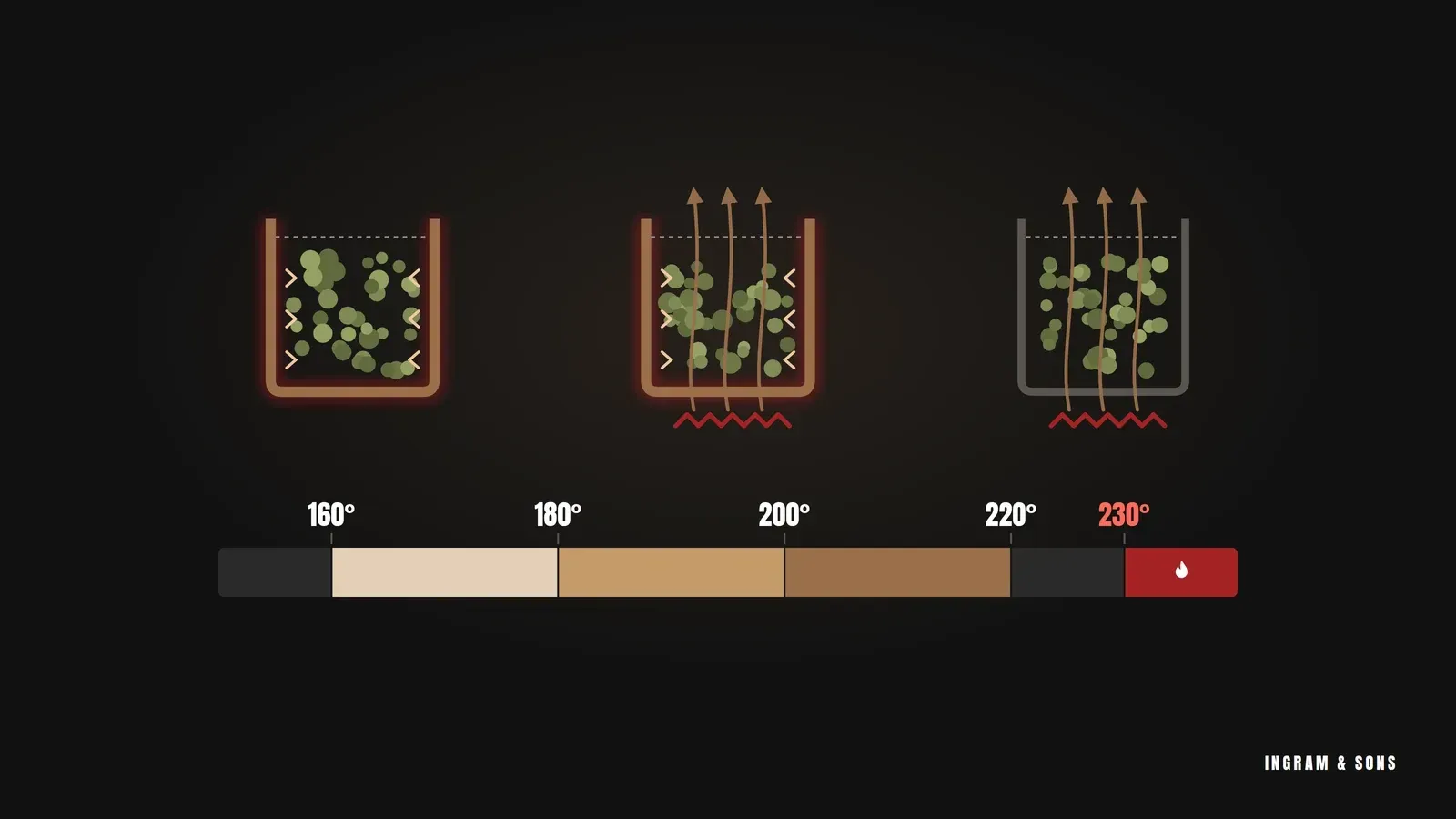
The whole trick is heat. The active compounds in cannabis vaporize at a lower temperature than the plant needs to catch fire. Cannabis starts to combust at roughly 230°C (446°F). Dry herb vaporizers work below that line, usually somewhere between 160°C and 220°C, so THC and terpenes leave the plant as vapour while the plant material stays in the chamber.
That gap is the entire category. Everything else, from a $70 DynaVap to a desktop unit that never leaves the coffee table, is a different way of hitting that window and holding it there.
How dry herb vaporizers work
Strip away the branding and every dry herb vaporizer has the same three parts: a power source (usually a battery), a heating element, and a heating chamber, sometimes called the oven, where the ground flower sits. Most also have a mouthpiece with a cooling path, because vapour straight off a hot chamber is warm.
What sets them apart is how the heat reaches the flower. Dry herb vaporizers use either conduction or convection, and plenty now combine the two.
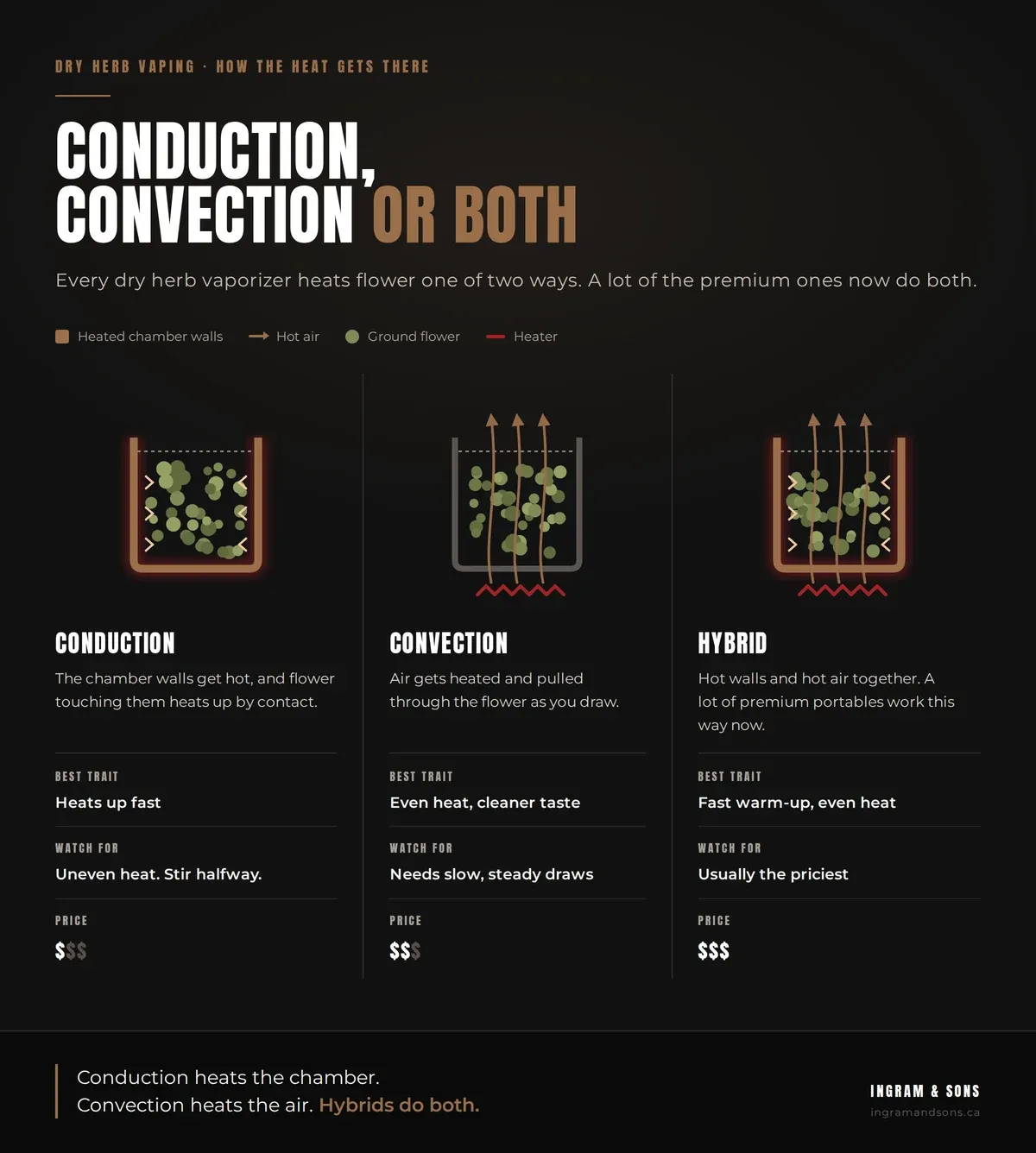
Conduction heats the chamber walls, and the flower touching them heats up by contact, the way food cooks in a pan. Conduction vaporizers heat up fast and tend to be simpler and cheaper. The catch is uneven heating: flower against the wall cooks faster than flower in the middle, so you stir it partway through.
Convection heats air and pulls it through the flower. Convection heating is more even and usually tastes cleaner, but convection vaporizers ask for slower, steadier draws and they usually cost more.
Hybrid vaporizers use both, and a lot of the premium dry herb vaporizers sit here now. Storz & Bickel's Mighty+ and Crafty+ both heat this way.
The other spec that matters is temperature control. Cheaper vapes give you three or four preset heat levels. Better ones give you precise temperature control, one degree at a time, sometimes through an app. You don't need that to enjoy one, but it's the feature that changes the vaping experience most.
Dry herb vaping vs smoking: what's actually different
Neither one is the upgrade. They're two ways to use the same flower, and plenty of people keep both around. Here's what changes.
Taste. Terpenes carry the smell and flavour of a strain, and they're fragile. At low vaporizer temperatures you taste a lot of them: citrus, pine, pepper, gas, whatever that cultivar has going on. A joint tastes like flower and smoke together, and a lot of people love exactly that.
Smell. Vapour smells like warm flower, sometimes a bit like toast or popcorn, and it clears out of a room faster than smoke. It doesn't hang on clothes or curtains the same way. It isn't odourless, though.
Effort. A joint is roll, light, enjoy. A vaporizer means charging, loading, waiting anywhere from a few seconds to a couple of minutes for it to heat, and cleaning. Some people like the tinkering. Some people want a pre-roll. Both are correct.
Cost. A vaporizer is money up front. After that you're buying the same flower you'd buy anyway, and compared to smoking, a lot of people find a small bowl goes further than they expected.
Leftovers. No ash. What comes out of the chamber is brown, toasted flower, usually called AVB (already vaped bud). Some people save it for cooking.
Is dry herb vaping bad for your lungs?
This is the most searched question about dry herb vaping, and it's one a cannabis store shouldn't be answering. We're not doctors, and the law doesn't let us make health claims about any way of using cannabis. So here's what we can tell you.
A vaporizer that's working properly doesn't burn the flower, so it doesn't make smoke. That's what the device does. What that means for your own health risks is a question for Health Canada and your doctor. Health Canada has a plain-language page on minimizing your risk when smoking, vaping and dabbing cannabis. It's short and worth reading before you buy any vaping device.
A few things apply however you inhale: keep your device clean, don't share mouthpieces, and if your lungs are a concern, talk to a doctor, not a budtender.
Does dry herb vaping get you high?
Yes. Same flower, same THC, so a dry herb vape gets you high, and it comes on within minutes, the same as smoking.
It can also land harder than people expect. In a 2018 Johns Hopkins study published in JAMA Network Open, 17 adults who rarely used cannabis took the same doses of THC, once smoked and once vaporized. At both doses, vaporized cannabis produced higher blood THC levels and stronger effects. It was one small study of infrequent users, so don't read too much into the exact numbers. The takeaway still holds: if you're used to smoking, don't assume the same number of puffs lands the same way.
Take a few small draws, then give it 10 to 15 minutes before deciding you need more. Temperature changes things too, which brings us to the next part.
What temperature should you vape dry herb at?
There's no single right number, but there's a well-worn range. Lower temperatures give you lighter vapour and more flavour. Higher ones give thicker vapour, a heavier high and more harshness. Most dry herb vaporizers top out somewhere around 210 to 220°C, on purpose, to keep vaporization under the combustion line.
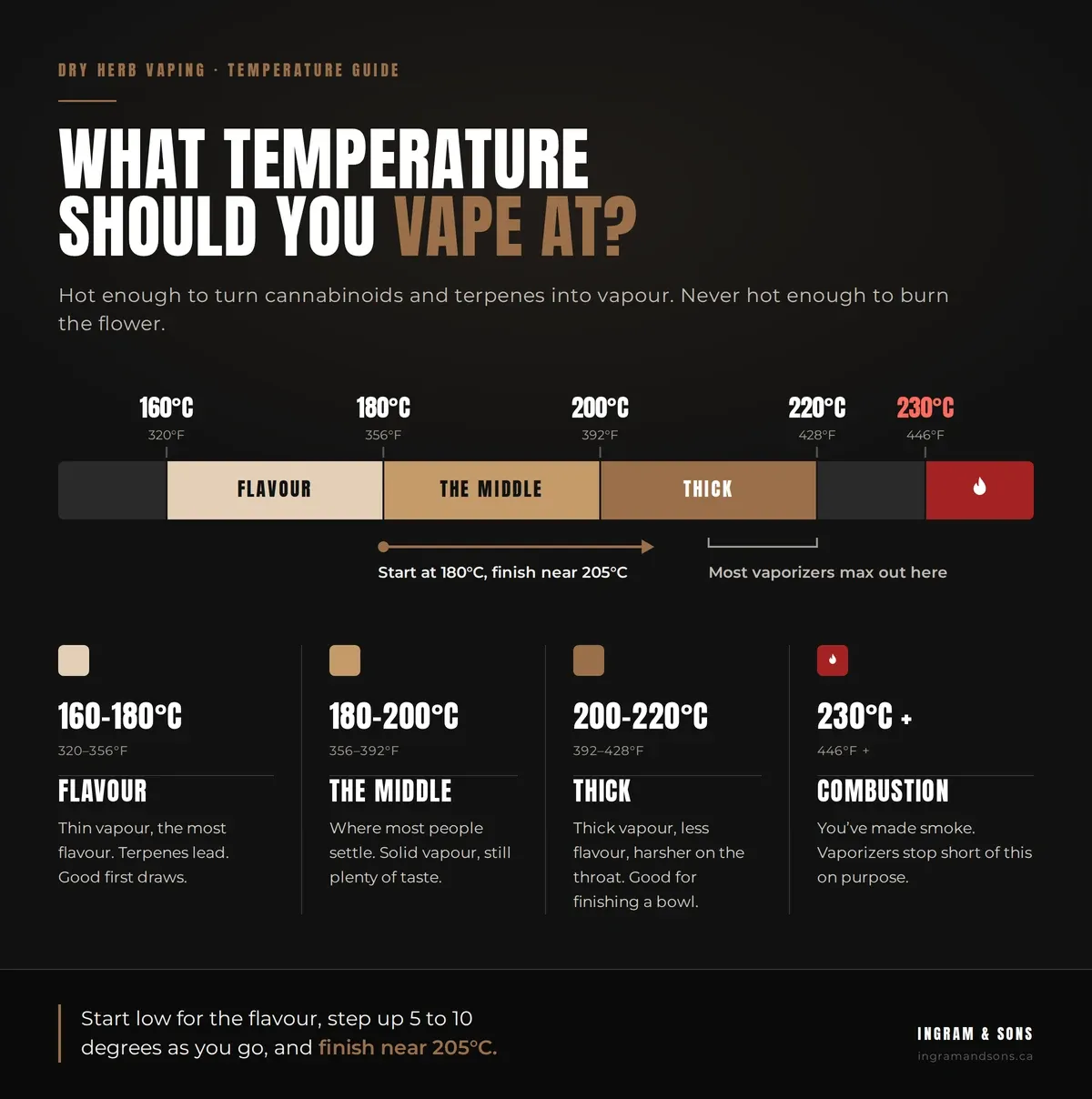
- 160 to 180°C (320 to 356°F): Thin vapour, the most flavour. Terpenes lead. Good first draws.
- 180 to 200°C (356 to 392°F): Where most people settle. Solid vapour, still plenty of taste.
- 200 to 220°C (392 to 428°F): Thick vapour, less flavour, harsher on the throat. Good for finishing a bowl.
- 230°C (446°F) and up: Combustion. You've made smoke.
A lot of people step it up as they go: start a bowl around 180°C, finish near 205°C. You get the flavour up front and the rest of the flower's worth at the end. If your device only has presets, start on the lowest temperature setting and work up.
Types of dry herb vaporizers
There are four main kinds, and they suit very different people.
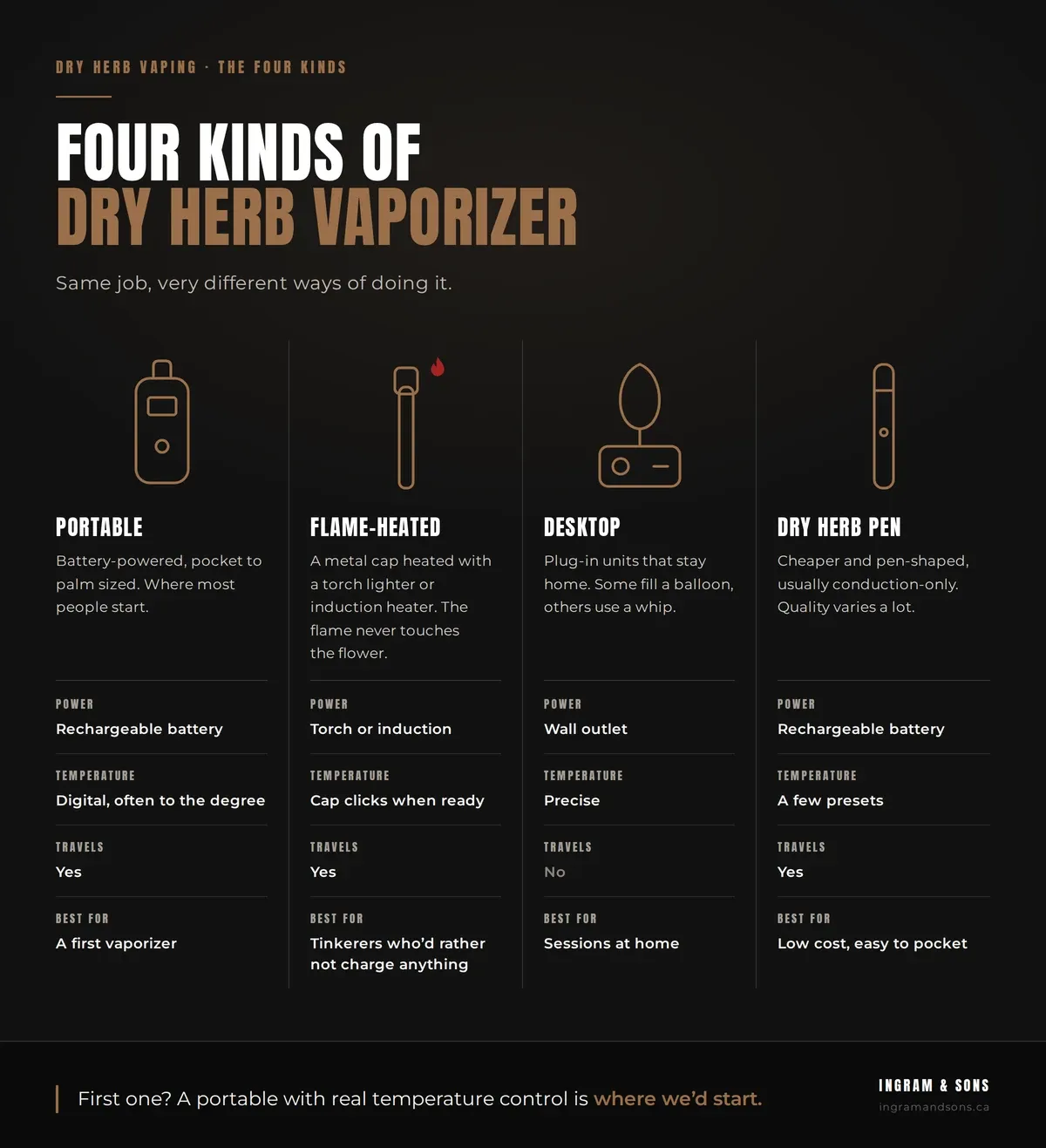
Portable vaporizers. Battery-powered, pocket to palm sized, with digital temperature control. This is where most people start and where most of the good hardware lives. The Mighty+, Crafty+ and Arizer's Air line are all portable dry herb vaporizers.
Flame-heated vaporizers. DynaVap is the best-known. There's no battery: you heat a metal cap with a torch lighter or an induction heater until it clicks, then draw. The flame heats the metal, never the flower. They're small, tough and cheap to run, with a real learning curve.
Desktop vaporizers. Plug-in units that stay home, like the Storz & Bickel Volcano, which fills a balloon you inhale from, or Arizer's Extreme Q and V-Tower. A desktop vaporizer is powerful and precise, and it doesn't travel.
Dry herb vape pens. Cheaper, pen-shaped, usually conduction-only with a few preset temperatures. Handy and discreet. Quality varies a lot, and the cheap end tends to taste roasted.
If you're buying your first one, a portable vaporizer with real temperature control is where we'd start. You'll learn what temperatures you like, and a high-quality portable will outlast two or three cheap pens.
How to use a dry herb vaporizer
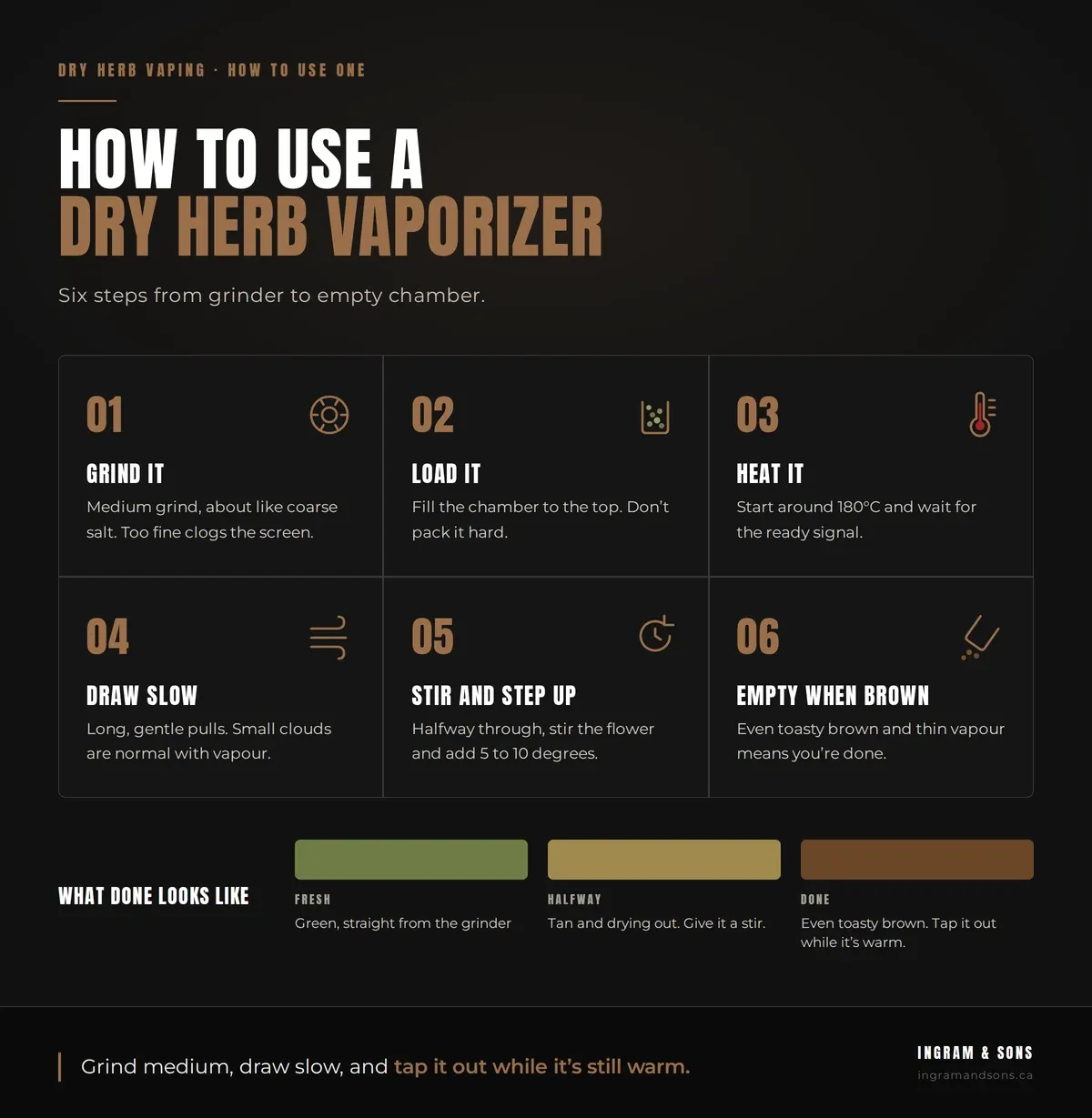
- Grind it. Aim for a medium grind, about like coarse salt. Too fine and it clogs screens and ends up in your mouth. Too chunky and it heats unevenly. A grinder is the one accessory you actually need.
- Load the chamber. Fill it to the top without packing it hard. Convection likes airflow, so keep it loose. Conduction likes contact, so pack it a little snugger.
- Heat it. Pick a temperature (180°C is a good start) and wait for the ready signal.
- Draw slow. Long, gentle pulls work better than hard ones. Vapour is thinner than smoke, so a small cloud doesn't mean nothing's happening.
- Stir and step up. Halfway through, give the flower a stir and nudge the heat up 5 to 10 degrees.
- Empty it when it's brown. When the flower is an even toasty brown and the vapour thins out, you're done. Tap it out while it's warm, it comes out easier.
How often should you clean a dry herb vaporizer?
More often than you'd like. Resin builds up in the chamber, the screens and the mouthpiece, and a dirty vape tastes stale and draws tight.
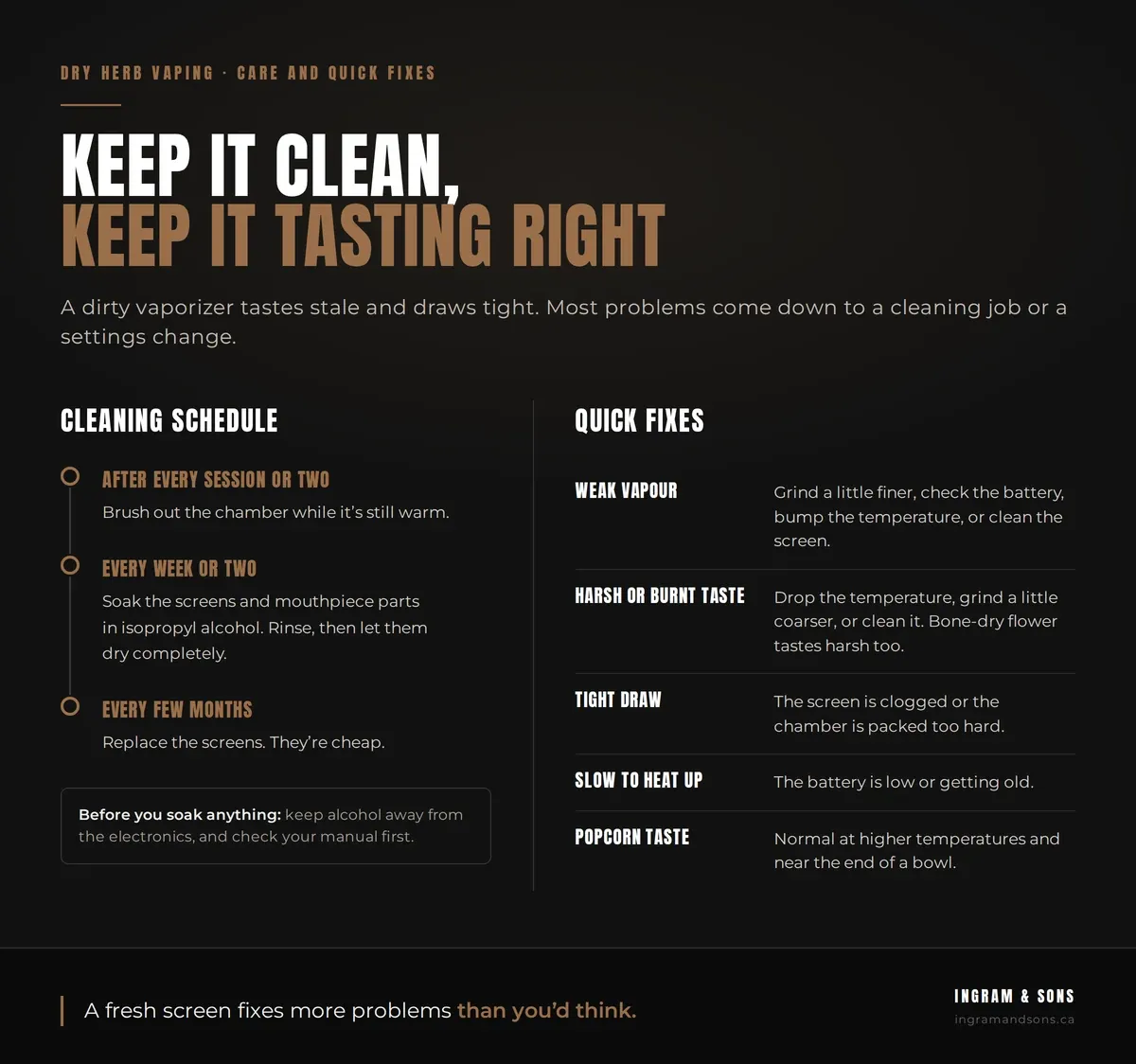
After every session or two, brush out the chamber while it's still warm. Every week or two, depending on how much you use it, take out the screens and mouthpiece parts, soak them in isopropyl alcohol, rinse, and let them dry completely before you put them back. Every few months, replace the screens. They're cheap, and a fresh screen fixes more problems than you'd think.
Most chambers are stainless steel, ceramic or glass. Check the manual before putting alcohol near anything with electronics in it, and keep a small cleaner kit (brush, cotton swabs, spare screens) with the device.
Common problems and quick fixes
- Weak vapour: grind a little finer, check the battery, bump the temperature, or clean the screen.
- Harsh or burnt taste: drop the temperature, grind a little coarser, or clean it. Flower that's bone dry tastes harsh too.
- Tight draw: the screen is clogged or the chamber is packed too hard.
- Slow to heat up: the battery is low or getting old.
- Popcorn or toast taste: normal at higher temperatures and near the end of a bowl.
Frequently asked questions
What's the difference between a dry herb vape and a vape pen?
A vape pen heats vape oil (a cannabis extract) in a pre-filled cartridge. A dry herb vape heats ground flower you load yourself. Different hardware, different product, different taste. If you're after settings for vape cartridges, our voltage guide covers that side.
Can neighbours smell dry herb vape?
Less than smoke, and it fades faster, but it isn't odourless. The vapour smells like warm flower, and the chamber smells strongest when you empty it. A closed door and an open window go a long way.
Will a dry herb vape set off a smoke alarm?
Usually not, because vapour is thinner than smoke and clears quickly. A big cloud blown right under a detector can still trip one.
Where can I vape dry herb in Ontario?
The same places you can smoke cannabis. Your own home is fine (check your lease or condo rules), and so are many outdoor spaces where tobacco smoking is allowed. Not in enclosed public places or workplaces, and never in a vehicle or boat that's being driven or will be driven.
Can I use concentrates in a dry herb vaporizer?
Some models take concentrate with an add-on, like the liquid pads Storz & Bickel makes for the Mighty+ and Crafty+. Most are made for dry herbs only. Never drip oil straight into a dry herb chamber unless the manual says you can.
How long does a dry herb vaporizer last?
A good one, looked after, lasts years. The battery usually goes first. Some devices have swappable batteries and many don't, so check before you buy.
Are dry herb vaporizers worth it?
If you like tasting your flower, use cannabis often, or want to skip the smoke, probably yes. If you use cannabis now and then, or you like rolling one up, a pre-roll is simpler and cheaper, and there's nothing wrong with that.
Come have a look
We carry portable dry herb vaporizers from Storz & Bickel and Arizer, DynaVap's flame-heated line, and the screens, balloons and vape accessories that keep them running. Stock on devices moves, so ask what's in, and we'll walk you through how each one loads and heats before you buy. If you'd rather buy dry herb vaporizers online, browse the vaporizer shelf and pick it up in store.
Curious about the oil side of things? Start with Cannabis Concentrates 101.